


While there is an overlap between the services of a Certified Public Accountant and a CFP® professional (CERTIFIED FINANCIAL PLANNER®), there are also essential differences. Knowing what services each offers is key to helping you make the best financial decisions for your situation. For example, which professional can best answer your questions about gifting and inheritance? Which can help you with determining how much you need to retire? So read on, find out, and get an understanding of each advisor’s role in your financial future.
Stop Managing Your Advisors. Start Making Decisions.
At Team Hewins, we act as your financial quarterback, coordinating with your existing professional team so you can stop being the middleman. Don’t have a CPA yet? We can refer you to our vetted, trusted network and handle the introduction for you. We believe in direct collaboration—we handle the back-and-forth so you can focus on the big picture.
Which path are you on?
To get the most out of this guide, select the category that matches your current priority:
- “I have a specific tax filing or deduction question.”
- Let’s jump to: The CPA’s Strategic Role
- “I’m navigating a complex life event (Business exit, Equity compensation, or Estate/Legacy planning).”
- Let’s jump to: The Financial Advisor’s Value
- “I have both professionals, but they don’t seem to be in sync.”
- Let’s jump to: The Coordination Gap
The Strategic Filter: Who Owns the Outcome?
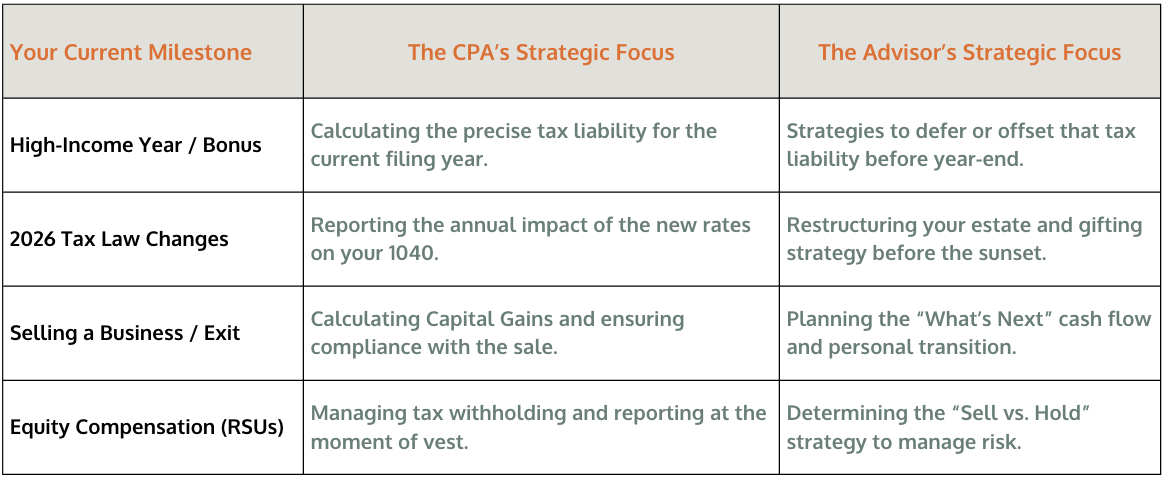
While roles overlap, the professional bridge is where your wealth is actually protected. Your financial advisor should be knowledgeable on taxes and able to help you understand the tax implications of your investment decisions , but will likely defer most tax questions to your CPA. Use this table to see who leads on your current priorities:
The CPA’s Focus: Tax Compliance & Reporting
How do you know whether you need a CPA or a financial advisor? You likely need a CPA if you find yourself searching the internet for answers to tax questions or asking friends and family for advice. If this sounds familiar, it’s time to turn to a professional.
When interacting with the Internal Revenue Service, a Certified Public Accountant is key because the CPA’s primary focus is on accounting and tax planning. In addition, a CPA is proficient on today’s tax code. The more complex your financial situation, the more you’ll benefit from having a CPA in your corner. A CPA will understand the tax implications of your investments, expenses, and other elements that factor into your tax return.
Does a CPA help with financial planning?
A CPA ordinarily does not provide personal financial planning services. CPAs support their clients on items, such as preparing and filing taxes, and making recommendations on ways to reduce your tax burden. Second, they do the accounting for businesses. If you’re an entrepreneur or business owner, hiring a CPA might be a good move depending on the size and complexity of the operation.
If you are looking for financial planning that goes beyond taxes and accounting, then you should consider a CFP® professional. Many people with high net worth or increasingly complex finances don’t think of it as an either/or question. They use both a CPA and financial advisor as part of their financial team.

The Advisor’s Focus: Holistic Wealth Strategy
When you need an overview of your complete financial picture or help to figure out when you can retire, the best person for the task is a CFP® professional. A financial planner will incorporate all factors of your situation to make recommendations on all aspects of your finances, including cash flow, retirement, investments, your estate planning, insurance, and college savings. It’s a great way to keep on top of your overall financial picture and to ensure you achieve your financial goals.
Your accountant can recommend tax strategies, but your financial planner will help you implement those recommendations and give you investment advice on the most efficient tax approach within your portfolio. Turn to your CFP® professional to make sure you’re staying on track.
Common Scenarios: Who Takes the Lead?
– Filing vs. Forward-Looking Planning
The deadline to file your income tax return approaches every spring, and it’s the busy season for CPAs. Your financial advisor can respond to general tax inquiries, but the best person for the job of preparing and filing tax returns is your CPA. In addition, tax laws change over time, and your CPA will keep up with the latest developments and how they affect your tax return.
– Buying and Selling Real Estate
You may need advice on selling a property and may be considering asking your CPA or your financial advisor. You can discuss the overall financial implications with your CFP® professional, but turn to your accountant to determine what you’ll take home after paying taxes. If the tax bite is too big, consider a Section 1031 exchange. This could be a good way for you to defer your tax liability on real estate that you’re holding as an investment. Either a CPA or a CF can explain how this works, but it’s your accountant who puts the 1031 into motion.
– Best Financial Fit for Business Owners
A CFP® professional can help you look at your overall risks and potential rewards if you are starting a business. But your CPA can tell you if it is best to structure the business as an LLC, a partnership, an S corporation, or a sole proprietorship.
Do you know which accounting method is the best fit? Depending on your business, there might be reasons to choose the cash over the accrual method, or vice versa. Rest assured that a qualified CPA can explain which is the best choice.
Other areas of CPA professional knowledge include the potential taxation of your estate, sales, and personal property taxes, as well as the best way to structure gifts and the need for estimated quarterly payments to the IRS.
CPA and CFP® Professional Working Together for You
While we’ve been discussing the differences between financial professionals, financial success is a team effort. Each professional contributes a specific skill set. And when they work together, their power is multiplied.
The Coordination Audit: 5 Questions For Your Team
If your CPA and Advisor haven’t talked in the last 6 months, ask them these questions to ensure no value is leaking from your plan:
- How are we positioning my portfolio to hedge against the 2026 tax exemption sunset?
- Are we harvesting tax losses now to offset the gains from my equity compensation?
- Is my withdrawal sequence (Taxable vs. Tax-Deferred) optimized for my 2026 tax bracket?
- Have we reviewed my last three years of returns to identify missed Roth conversion opportunities?
- Who is responsible for tracking the cost basis of my alternative investments so there are no surprises at filing?
Did your situation change over the year? Perhaps you received an inheritance or are going through a divorce or other life transition. You may be planning to buy or sell a significant asset. Or maybe you changed jobs and received equity compensation in your new package—but you’re not sure how that fits into your total financial picture or what the tax implications might be. Whatever the situation, your team will make sure that you are covered from an overall financial and tax perspective.
An open line of communication allows your team to discuss what is best for you in your specific situation, rather than viewing it in isolation.
While there is an overlap between the services of a Certified Public Accountant and a CFP® professional, there are also essential differences. Knowing what services each offers is key to helping you make the best holistic financial planning decisions for your situation.
In summary, when your CFP® professional and Certified Public Accountant work together, great things can happen.
Finding the Right Players for Your 2026 Financial Team
Building a financial team can be challenging, and you might be unsure about the best approach. Whether you need a specialized estate planner, or a dedicated insurance specialist, Team Hewins helps you identify and integrate the right professionals into your plan tailored to your complexity:
- Estate Attorneys (for legacy and trust planning)
- Insurance Specialists (for risk mitigation)
- Trust Officers (for generational wealth)
- Philanthropic Consultants (for charitable giving strategies)
From Service Providers to a Unified Strategy
At Team Hewins, we act as your financial coordinator, bridging the gap between your tax, legal, and investment worlds. We believe your wealth shouldn’t be managed in silos—it should be synchronized.
- Direct Collaboration: We handle the back-and-forth. Your CPA gets updates directly from us, and your attorney receives coordinated recommendations—taking you out of the middle.
- Tax-Centric Planning: We work in lockstep with your CPA to ensure your investment moves align with your tax strategy.
- Holistic Integration: We don’t just manage wealth; we build teams. From estate planners to family law attorney, and insurance specialists, we ensure every professional on your field is synchronized.
The Difference Between CPA and Financial Advisor: Education Requirements
- Both a CPA and financial advisor with a CFP® certification must meet rigorous education requirements for licensing. It is worth noting that there are various financial advisors who may not have a CFP® certification. Be sure you understand what qualifications your advisors have before signing on with them.
- Both CPA and CFP® professionals require a bachelor’s degree and a specified amount of college or university-level credits in their respective areas. The CPA education requirements focus more on accounting and auditing skills whereas the CFP emphasizes comprehensive financial planning knowledge. After meeting the course requirements, a CPA or CFP® needs to pass the CPA Exam or CFP Exam, respectively, and gain a specified number of hours of professional experience.
- While both designations demand rigorous study and commitment, the CFP® certification has one final requirement. Financial advisors who wish to become a CERTIFIED FINANCIAL PLANNER® professional must adhere to an ethical code to act as a fiduciary and always provide advice that is in their client’s best interest. While CPAs are typically not considered to be fiduciaries to clients, they adhere to the American Institute of CPAs (AICPA) Code of Professional Conduct with standards of conduct that are similar to a fiduciary relationship.
As you can see, the educational requirements also delineate the difference between a CPA and a CFP® professional in alignment with the services they can provide you. We recommend making sure your professional team has the right certifications for the job.
Moving Beyond the Filing: Your Strategic Review
Filing your taxes shouldn’t be a source of annual stress. For high-earning professionals with complex equity and investment income, the paperwork hurdle is often the biggest barrier to clear financial decision-making. By coordinating your document trail with your overall wealth strategy, we ensure your CPA has exactly what they need to maximize your deductions for the coming year.
Ready to close the coordination gap? A Team Hewins CFP® professional acts as your financial coordinator, ensuring your CPA, Attorney, and Advisor are finally in sync. Book a complimentary Big Decisions Clarity meeting to see how an integrated team can simplify your 2026 planning.