
Key points
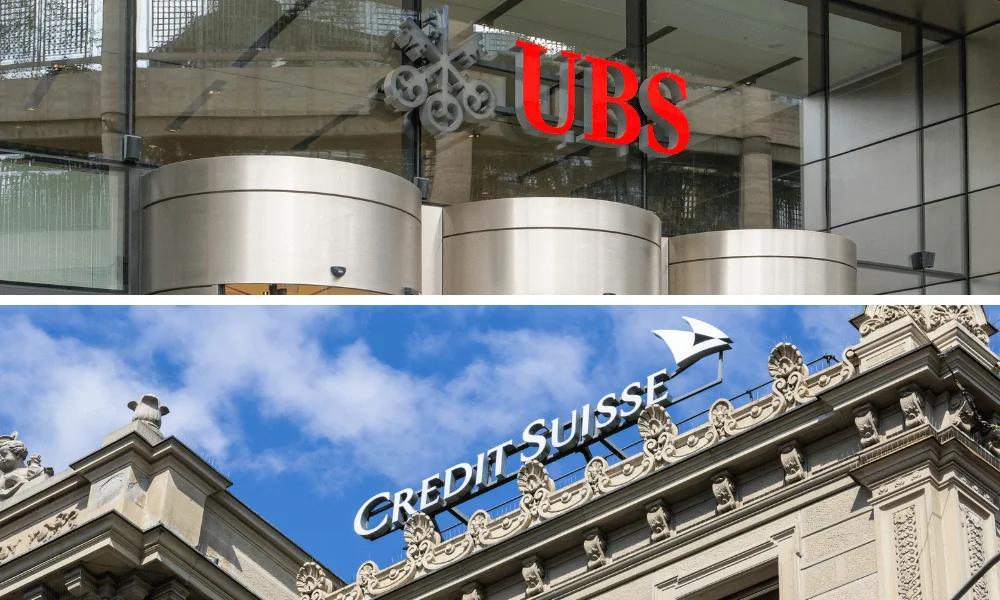
- Continuing stress in the banking industry culminated Sunday in the acquisition of Credit Suisse by United Bank of Switzerland (UBS).
- The financial sector and regional bank stocks have been hit hard amid a flight to safety that has seen strength in bonds and large tech stocks.
- With central banks supplying massive liquidity to limit the contagion, the Fed may pause further rate hikes after its Wednesday meeting.
- Diversification and discipline remain essential in times of market stress.
The last two weekends have been quite extraordinary in the banking world. A week ago, US regulators were dealing with the fallout of the failures of Silicon Valley Bank and Signature Bank and made the decision to fully back all deposits at both banks. This past week, long-troubled Swiss bank, Credit Suisse (CS), faced failure as clients and counterparties pulled away from the bank. Swiss regulators pushed its larger and healthier rival Union Bank of Switzerland (UBS) to buy CS.
CS has struggled for the last 15 years going back to the 2008 Global Financial Crisis. Last Monday CS reported material weakness in its financial reporting after an extensive investigation, and then on Tuesday, one of its primary investors, Saudi National Bank, announced it would not provide further capital to the bank. By the end of the week, it was clear deposits and counterparties were fleeing, and UBS was called upon to negotiate a deal over the weekend.
Credit Suisse was worth as much as $70 billion in 2007.1 On Friday, CS’s market value was just $8 billion. CS was acquired by UBS on Sunday for only $3.2 billion with a $100 billion backstop from the Swiss National Bank.2
There were no great options here, but at least UBS has full authority to operate CS as they see fit and can cut costs and absorb the CS balance sheet accordingly.
Central Banks React
The impact of the Federal Reserve and European Central Bank interest rate hikes clearly has been felt with the most vulnerable banking institutions in the US and now Switzerland not able to withstand the pain. Central banks across the globe are supporting the fallout with massive liquidity to limit the impact of any further contagion. While the Federal Reserve may raise rates one more time at its Wednesday meeting, it is likely to take a pause with further hikes given the stresses in the banking system. Fed Chair Powell’s press conference will get a lot of attention Wednesday afternoon.
Bank Stocks Hit Hard
In the last two weeks financial stocks have suffered, particularly regional US banks. The SPDR S&P Regional Banking ETF (KRE) has fallen 31.2% over the last month.3 For the moment there is an implicit guarantee by the US Government through the FDIC to cover all deposits. Key legislators and the regional banks are calling for either a large increase (or even no maximum amount) in the current insurance cap of $250,000 per depositor. We’ll see what can get done in the coming weeks.
Stock and Bond Markets
The banking stress has triggered a flight to ‘safety’ in both markets. In the stock market funds have flowed to the large self-funded technology companies like Microsoft and Alphabet (Google). The Nasdaq 100 fund (QQQ) is up 5.8%4 over the last week–its best week since November!5 Meanwhile, US Treasury yields have dropped significantly, with the 10-year Treasury yield falling from over 4.0% two weeks ago to about 3.4% today.6 The fall in yields is a big help to bank bond portfolios.
Banks are likely to tighten lending standards which, along with the impacts of all the Federal Reserve interest rate hikes, may do enough to quell inflation in the coming months, but economic growth will suffer. The Fed’s liquidity injection into the banking system and expected pause in rate hikes now shifts the Fed to potentially become more of a tailwind for markets, rather than the headwind it has been for the last 18 months.
Portfolio diversification is working, with core bonds and growth equities supporting portfolios through this banking stress. At some point (soon hopefully) markets will have fully priced in the recessionary impacts of the banking stress, and, eventually, a recovery in those share prices most affected will develop. Discipline, diversification, and patience gets us through these challenging times.
We are here to help and support you. Please never hesitate to reach out to your Team Hewins advisor.
- “Credit Suisse (CS) – Market Capitalization.” Companiesmarketcap, Mar. 2023, companiesmarketcap.com/credit-suisse/marketcap. Accessed 20 Mar. 2023.
- Thompson, Mark. “UBS Is Buying Credit Suisse in Bid to Halt Banking Crisis.” CNN, 20 Mar. 2023, www.cnn.com/2023/03/19/business/credit-suisse-ubs-rescue/index.html. Accessed 19 Mar. 2023.
- Source: Morningstar Direct. Data as of 3/19/23.
- Source: Morningstar Direct. Data as of 3/19/23.
- Harring, Alex. “First Republic Offered $30B Lifeline From Nation’s Largest Banks.” NBC News, 17 Mar. 2023, www.nbcnews.com/business/business-news/dow-closes-nearly-400-points-lower-first-republic-regional-banks-resum-rcna75556. Accessed 19 Mar. 2023.
- Daily Treasury Par Yield Curve Rates, treasury.gov, Accessed 3/20/23.
Team Hewins, LLC (“Team Hewins”) is an SEC-registered investment adviser; however, such registration does not imply a certain level of skill or training, and no inference to the contrary should be made. We provide this information with the understanding that we are not engaged in rendering legal, accounting, or tax services. We recommend that all investors seek out the services of competent professionals in any of the aforementioned areas. Certain information provided herein is based on third-party sources, which information, although believed to be accurate, has not been independently verified by Team Hewins. Team Hewins assumes no liability for errors and omissions in the information contained herein. Certain information contained herein constitutes forward-looking statements. Team Hewins does not guarantee the achievement of long-term goals in the portfolio review process. Past performance is no guarantee of future results, and a diversified portfolio does not guarantee a positive outcome. Nothing contained herein may be relied upon as a guarantee, promise, assurance, or a representation as to the future.